Ink and Paper Chopmarks
Ink and paper chopmarks are an interesting topic related to physically punched chopmarks. It is believed that ink chopmarks may have acted as a replacement for punched chopmarks, starting in the late 1800's. Paper chopmarks appear to be something different, added to gifts for good luck, but there isn't much documentation to be sure on this topic.
1862-Go YF Mexican 8 Reales 2 coin clump with ink chopmarks

Details:
This two-coin clump consists of Mexican 8 Reales corroded into a single mass, stacked so that a cap and rays obverse is exposed on each outer face.
Encrustation covers the date and mintmark on the second coin, so only the 1862 Guanajuato coin can be attributed and the coin beneath it can be
identified. The recorded weight of 54.26 grams for the pair sits marginally above the 54.14 grams two undamaged coins would weigh, which is consistent
with a burial in which corrosion added mass. Coins stacked in a bag, a box, or a sealed jar routinely cement themselves together this way, the copper
corroding out of the alloy and hardening across the contact faces.
This pair was dug out of the ground in China, assumed recently. Digging of this kind is neither licensed nor legal there, as metal detecting is not a permitted hobby and all cultural relics remaining underground are the property of the state under the Cultural Relics Protection Law, which the Standing Committee of the National People's Congress revised on November 8, 2024 and brought into force on March 1, 2025, raising the maximum fine from 500,000 yuan to 10 million yuan. Enforcement has not suppressed the practice...in December 2025 construction machinery working an agricultural plot at Chedun Town in the Songjiang District of Shanghai was reported to have turned up silver coins, and within two days thirty to forty people were digging the site with shovels and handheld metal detectors, working into the night by the light of mobile phones, with coins said to be changing hands on the spot for a few hundred yuan each. The district cultural heritage office and the police closed the site pending a supervised excavation, while stating that no official had yet seen any of the coins and that nobody had turned one in.
The coloring on these coins is vivid, even for a ground find, bright green and blue across one face and purple across the other, with the purple side noticeably sparkling in light. At .903 fine the alloy is roughly nine and a half percent copper, and copper is the more reactive of the two metals, so in burial it corrodes preferentially and migrates to the surface while the silver is left behind. Almost all of the green and blue is copper reacting on the surface of the silver, the likely compounds being malachite and azurite where soil moisture and carbonate were available, the copper trihydroxychlorides of the atacamite group where chloride was present, which account for the most vivid greens, and copper sulfates such as brochantite. The rust and ochre streaking is iron oxide picked up from the surrounding soil, probably over an underlying layer of cuprite, the red orange copper oxide that normally forms first against the metal.
The purple face has more depth than surface toning, and the sparkle rules out normal toning, since interference colors sit flat on a smooth surface and do not sparkle. The most likely candidate is silver chloride, the mineral chlorargyrite that older writers called horn silver, which is the normal product of long burial in chloride bearing ground. Freshly formed it is colorless to waxy grey green, but light reduces the outer part of it back to colloidal metallic silver, and that reduction is what carries it to violet, then purple brown, and eventually to something close to black, so the purple likely developed after the coin came out of the ground and is probably still changing. Chlorargyrite is cubic and its luster runs from resinous to adamantine, so where it grows as a druse of small crystals the surface is covered in flat reflective faces, accounting for the sparkle. Silver sulfide is the usual explanation offered for purple on silver and is a poor fit here, because sulfide is purple only as an interference film a few hundred nanometers thick and goes grey and then black at any thickness worth calling a crust. Covellite and stromeyerite, the copper sulfide and the silver copper sulfide, are indigo to purple with a submetallic luster and may be mixed into the crust, but neither would build the bulk of it on its own.
Taken together the two faces point to a chloride rich burial, since the most vivid greens on the other side are copper trihydroxychlorides and chlorargyrite is the silver end of the same chemistry. The difference between the faces then comes down to how far the corrosion ran on each: on the green side it stopped at the copper, while on the purple side the copper appears to have been leached out first and the silver attacked afterward, which is also why that face has lost so much of its detail. The fused interior faces were sealed off from both processes. All of this is inference from appearance, and confirming any of it would require XRF, Raman, or X-ray diffraction analysis.
Both exposed faces carry ink chopmarks, which is worth noting because ink is a surface deposit and would be expected to be among the first things lost in the ground. Chinese ink is lampblack, essentially elemental carbon, suspended in an animal glue binder, and while the binder degrades the carbon itself is inert and insoluble, so the pigment particles tend to stay where they were laid down and can end up sealed in place beneath the corrosion crust growing over them. That both coins are marked is consistent with their having been chopped in the same commercial setting and then put away together, which is the same conclusion the clump itself points to.
Provenance:
Purchased from the CoinsNB Auction 61, June 27 2026
Lot #388
Auction Description:
Mexico Federal Republic 1824 - 1897 8 Reales (Chinese ink Chopmarked; Lot with 2 coins, Weight all 54.26 gr) Silver (.903) 27.14g XF KM 377
1878-Do TB Mexico 8 Reales with "Happy Wedding" & Ink & normal chopmarks

Specifications:
27.07 g, .903 fine silver, .786 troy oz (actual silver weight)
Recorded mintage: unknown
Catalog reference: KM 377.4
Details:
In Chinese tradition, red is the color of joy, prosperity, and good fortune, and its presence at weddings is pervasive, in clothing, decoration, and the red envelopes
of lucky money exchanged between families. The 囍 character (shuāngxǐ, "double happiness"), formed by joining two 喜 characters meaning joy, has been the defining symbol
of Chinese wedding culture since at least the Tang dynasty, traditionally cut or printed on red paper as a blessing on the couple and their union. Silver coins have long
carried auspicious weight in this tradition, substantial, lasting, and valuable, and the 8 reales, as the dominant trade dollar across southern China through much of
the nineteenth century, would have been a natural choice for a wedding gift.
We can only guess about the purpose of the black ink stamp over the red paper. It may represent a merchant's or family's personal seal applied to formalize the gift, or possibly a later mark made when the coin changed hands, but whether it was part of the original presentation or added afterward is tough to say with certainty.
Notable chopmarks:
 囍 - xǐ - double happiness
 Small, partial sunburst chopmark
 Unknown chinese character chopmark
 Small 6-dot triangle chopmark
 昌 - chāng - light of sun; good, proper
Provenance:
From the Ron Waddell Collection
Purchased from Ron via private sale in September 2016
1886-Go RR Mexican 8 Reales with small chopmark & Ink chopmark

Specifications:
27.07 g, .903 fine silver, .786 troy oz (actual silver weight)
Recorded mintage: 4,127,000
Catalog reference: KM 377.8
Details:
A handsomely toned coin with wholly original ink stamped on the reverse. One tiny chopmark on the obverse.
Notable chopmarks:
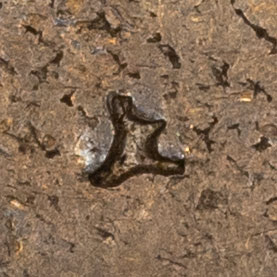
Unknown mark
Provenance:
Purchased on eBay in December, 2023 from a seller in Roseville, Illinois.
1892-Mo AM Mexican 8 Reales with small chopmarks & Seal ink chopmark

Specifications:
27.07 g, .903 fine silver, .786 troy oz (actual silver weight)
Recorded mintage: 4,127,000
Catalog reference: KM 377.8
Details:
This 1892 Mexican 8 Reales shows a black ink seal stamp reading 大豐號 (Dà Fēng Hào, "Great Prosperity Company"), likely applied by a Chinese merchant firm during
the coin's life in China, probably sometime in the late 19th or early 20th century. The coin itself shows significant environmental patina consistent with burial
or long-term storage alongside other coins. One possible explanation for this lies in the Nationalist government's currency reform of November 1935, which declared
all privately held silver to be state property and required citizens to surrender silver coins and bullion in exchange for the new paper currency, with illegal
possession punishable by confiscation and potential charges of treason. Faced with exchanging physical silver for paper issued by a government of questionable
stability, many chose instead to conceal their holdings, and coins buried or sealed in containers (such as pottery) would not necessarily have been recovered until
many years later. In fact, many chopmarked coins discovered today were only spared the melting pot because they were hidden away around the same period discussed
here.
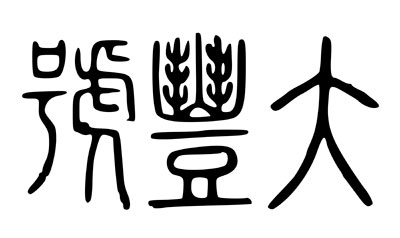
Ink stamps of this type had the practical advantage of leaving the coin's silver undamaged, and they represent a distinct variant of chopmarks whose application was not limited to any single trade or industry. The name 大豐號 follows the traditional merchant-house naming convention in which 號 (hào) identifies a firm organized along older, family or guild-based lines, a style of commercial identity distinct from the more modern Western-influenced 公司 (gōngsī) form that was gaining ground through the Republican period. The characters 大豐, combining "great" and "abundant/prosperous," were among the most auspicious pairings available in Chinese commercial naming, carrying strong associations with bountiful harvest and commercial prosperity. The combination was so appealing that it became common among firms across different cities, trades, and time periods. This makes attribution effectively impossible. Without a geographic marker or additional documentary evidence, the 大豐號 ink stamp tells us that this coin passed through the hands of a Chinese merchant firm and entered local commercial circulation, but which specific 大豐號, in which city, and in which trade, remains a mystery.
Notable Chopmarks

 - Seal script variant of 號 - hào - mark, sign; symbol; number
 - Seal script variant of 豐 - fēng - abundant, lush, bountiful, plenty; hexagram ䷶
 - Liushutong script variant of 大 - dà - big, great, vast, large, high
 Two small unidentifiable chopmarks
 One small unidentifiable chopmark
 文 - wén - writing, literature, culture, (old) classifier for coins
 大 - dà - big, great, vast, large, high
Provenance:
From the June 2025 Hong Kong (SAR) Collectors Choice Online Auction: Chinese & Asian Coins: Session 3: World Coins Part 2
Lot #33552
Note: The auction description incorrectly described this coin as a Zacatecas 8 Reales, instead of Mexico City.
1893 Japan One Yen with regular chopmarks and ink "Double Happiness" mark

Specifications:
26.96 g, .900 fine silver, .780 troy oz (actual silver weight)
Recorded mintage: 10,403,477 (a common date)
Catalog reference: Y-A25.3
Details:
Similar to the paper chopmark shown above, this Japanese Yen features an ink chop with the Chinese word '囍', which figuratively translates to "double happiness"
and is one of the most popular of the four common blessings to impart on a newly married couple. Usually we see this word affixed onto silver dollars with red
paper and glue, but ink is also acceptable. This coin also features a few merchant chopmarks, as shown below.
Notable chopmarks:
 囍 - xǐ - double happiness
 它 - tā - it; other
 C - Latin-letter chopmark - A single Latin letter used as a chopmark. On foreign trade coins a Latin initial is most often the private mark of a Western merchant, assayer, or trading house that handled the coin, recording who tested or accepted it much as a Chinese shroff's name-stamp did. The specific person or business behind an individual letter is generally not identifiable, and the same letter could belong to different marks in different ports.
Provenance:
From Ben Dalgleish, a collector who finds chopmarked coins in the coin markets of Hong Kong, December 2021. Ben found this coin in the Ho Mong Kok market, purchased from a dealer at a shop called Curious Collections in March 2021.
1894-Mo AM Mexican 8 Reales with Ink chopmark

Specifications:
27.07 g, .903 fine silver, .786 troy oz (actual silver weight)
Recorded mintage: 4,127,000
Catalog reference: KM 377.8
Details:
An attractive, semi-prooflike coin with a very bold ink stamp on the reverse side. It also appears there was an ink stamp on the obverse side as well,
although that stamp is no longer intact. The auction description mentions the reverse stamp is a "charity" ink mark, this comment requires further
investigation.
Provenance:
April 2025 Hong Kong (SAR) Showcase Auction: Session 7: Internet Only: World Coins Part 2
Lot #46110
Auction Description:
MEXICO. 8 Reales, 1894-Mo AM. Mexico City. NGC Unc Details--Stained.
KM-377.10; DP-Mo80. "Charity" Ink Chop. A highly interesting and unusual example with a complex handwritten inscription on the reverse.
1895-Mo AM Mexican 8 Reales with Ink chopmark

Specifications:
27.07 g, .903 fine silver, .786 troy oz (actual silver weight)
Recorded mintage: 10,474,000
Catalog reference: KM 377.8
Details: Another ink chopmarked coin showing some ink on the obverse, and a more clear stamp on the reverse. Based on the style of the stamp, I wonder if this ink chopmark is more Japanese than Chinese.
Notable Chopmarks:
 Ink chopmark
 Small sunburst chop
 大 - dà - big, great, vast, large, high
 上 - shàng - top; superior, highest; go up, send up
Provenance:
From the Ron Waddell Collection
Purchased from Ron via private sale in September 2016
"Year 3" (1914) China Yuan Shih-kai Dollar with Ink Chops

Specifications:
26.4 g, .890 fine silver, .755 troy oz (actual silver weight)
Recorded mintage: unknown
Catalog reference: KM Y329
Details:
In early-20th-century China, ink chopmarks represent a late and often overlooked phase in the long tradition of merchant validation on silver coinage. Unlike punched chopmarks, which
physically tested and permanently marked a coin, ink chops were non-destructive and temporary, typically applied by banks, money shops, or commercial houses to indicate short-term
acceptance, counting, or clearance rather than metal verification. They were especially useful as machine-struck silver coins such as Yuan Shih-kai dollars and other republican issues
became widely trusted, reducing the need for aggressive testing. Ink marks could denote that a coin had been inspected, tallied, or approved for use within a specific transaction or
accounting period, and they were often intended to fade or be washed off once the coin moved on. Their presence reflects a transitional moment in China’s monetary culture, where
traditional habits of marking silver persisted, but adapted to a modernizing economy that increasingly favored standardized coinage and less intrusive forms of commercial validation.
Ink chops on coins in late Qing and early Republican China typically featured simple, easily recognizable characters or symbols rather than long inscriptions. Common marks include single Chinese characters indicating approval or completion (such as 正, 收, or 合), shop or bank names, abbreviated surnames, and occasionally auspicious symbols or numerals used for counting and accounting. Some ink chops incorporated red cinnabar ink, long associated with official seals, to lend authority and visibility.
Notable chopmarks:
 Large circular ink chopmark with calligraphy or script style characters
 Oval ink chopmark with letters "WAN"
Provenance:
From the Ron Waddell Collection
Purchased from Ron via private sale in September 2016
Previously purchased from Peter Hamilton, San Mateo CA.
"Year 3" (1914) China Yuan Shih-kai Dollar (regular chopmark and "Happy Wedding" paper chopmark)

Specifications:
26.4 g, .890 fine silver, .755 troy oz (actual silver weight)
Recorded mintage: unknown
Catalog reference: KM Y329
Details:
One more "double happiness" paper chopmark, used as a wedding gift, along with one tiny normal chopmark.
Notable chopmarks:
 囍 - xǐ - double happiness
 Small, unknown normal chopmark
Provenance:
Purchased on eBay in March 2013 from a seller in Chicago.